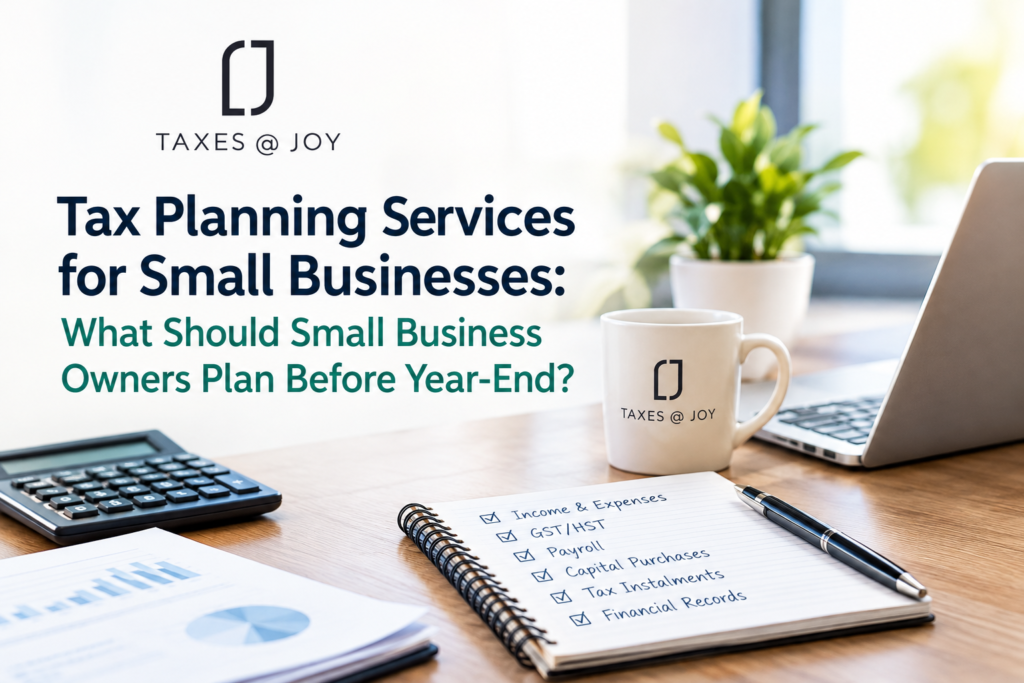
For many small business owners, year-end arrives with the same familiar list: close the books, collect receipts, check invoices, prepare payroll records and start thinking about taxes.
But tax planning should not begin when the return is already sitting on your desk. By then, many of the decisions that could have affected the year’s tax position may already have been made.
Good tax planning is more proactive. It means reviewing the business’s financial position before the year closes, identifying items that need attention, organizing records and considering legitimate tax and financial decisions while there is still time to act.
This is where tax planning services can provide practical value. Rather than looking at tax as a once-a-year filing exercise, business owners can use financial information throughout the year to prepare for upcoming obligations and make informed decisions.
For Canadian businesses, the details depend on the business structure, fiscal year, income, expenses and individual circumstances. The goal should not simply be to “pay less tax,” but to understand what the business actually owes, claim eligible amounts correctly and avoid unnecessary surprises.
What Is Tax Planning for a Small Business?
Tax planning is the process of reviewing a business’s financial situation and tax obligations in advance so that legitimate tax and financial decisions can be considered before filing.
For a small business, this may involve reviewing:
- Business income
- Operating expenses
- Outstanding invoices
- Accounts payable
- Payroll
- GST/HST obligations
- Capital purchases
- Business structure
- Tax instalments
- Available deductions and credits
- Previous tax information
- Upcoming business investments
The exact opportunities offered by tax planning services depend on the type and structure of the business.
For example, a sole proprietor and an incorporated business do not necessarily have the same tax considerations. A corporation also has its own fiscal period, and its T2 return generally must be filed within six months of the end of its tax year.
That is why effective tax planning starts with understanding the business, its financial position, and its obligations rather than applying the same checklist to everyone.
Why Should Small Businesses Start Tax Planning Before Year-End?
Canada Revenue Agency (CRA) requires businesses to maintain records that support their income and expense claims. Business records generally need to be retained for at least six years from the end of the relevant tax year.
1. Review Your Business Income
Start with the money coming into the business. Review sales, invoices, deposits and other business income to make sure the financial records are complete.
Look for:
- Unrecorded sales
- Outstanding customer invoices
- Duplicate entries
- Missing deposits
- Incorrectly categorized income
- Other business revenue
CRA states that business income records should identify information such as the date, amount and source of income, with supporting documents such as invoices, receipts and contracts. This review also provides a clearer picture of how the business actually performed during the year.
2. Review Business Expenses and Supporting Documents
Year-end is a useful time to go through expenses and confirm that business-related purchases have been recorded correctly.
Depending on the business, expenses may include:
- Advertising
- Rent
- Insurance
- Professional fees
- Office expenses
- Software
- Supplies
- Utilities
- Interest and bank charges
- Salaries and wages
- Vehicle expenses
- Travel
- Repairs and maintenance
CRA explains that reasonable current expenses incurred to earn business income may generally be deductible, while personal expenses cannot be claimed as business expenses. Some purchases are capital expenses and are treated differently.
That distinction matters.
A large equipment purchase, for example, should not automatically be treated in the same way as an ordinary office expense.
3. Separate Current Expenses from Capital Purchases
This is an area where business owners can easily become confused. An everyday operating expense and a long-term business asset may have different tax treatment.
Capital property can include items such as equipment, machinery, furniture or other assets used to generate business income.
Instead of automatically deducting the entire cost as a current expense, eligible capital property may generally be subject to Capital Cost Allowance (CCA) rules.
CRA explains that CCA is generally calculated based on the applicable class of depreciable property and the remaining balance of that class. Businesses do not necessarily have to claim the maximum CCA amount available in every situation.
This is one reason year-end business tax planning services can be useful. A professional can review the business’s circumstances and explain how applicable rules may affect the treatment of purchases.
4. Check Outstanding Invoices and Receivables
Profitability and cash flow is not the same thing. A business may have significant sales recorded but still be waiting for customers to pay.
Before year-end, review:
- Outstanding invoices
- Overdue customer balances
- Payments received but not yet recorded
- Potentially uncollectible amounts
- Customer accounts requiring follow-up
This is not simply an accounting exercise. Knowing how much money is actually expected to come into the business can help with cash-flow planning and upcoming tax obligations.
5. Review Your GST/HST Records
If your business is registered for GST/HST, make sure the relevant records are organized before year-end.
Review:
- GST/HST collected
- GST/HST paid on eligible business purchases
- Sales invoices
- Purchase receipts
- GST/HST returns
- Input tax credit documentation
- Outstanding amounts
The CRA requires businesses to keep records that support GST/HST reporting and related claims. Good bookkeeping throughout the year makes this review much easier.
It also reduces the risk of trying to reconstruct months of transactions when a filing deadline is approaching.
6. Review Payroll and Remittances
Businesses with employees have another important year-end responsibility. Payroll records should be reviewed to make sure deductions and remittances have been properly recorded.
CRA’s current 2026 guidance states that employers generally have to file T4, T4A, T4A-NR and T4A-RCA information returns by the last day of February following the calendar year. Remittance requirements depend on the employer’s remitter type and applicable schedule.
A year-end review can help identify missing payroll information before slips and returns need to be prepared.
7. Review Your Business Structure
Tax planning is not only about expenses.
The structure of a business can affect how income is reported and what tax obligations apply.
A business may operate as:
- Sole proprietorship
- Partnership
- Corporation
The appropriate structure depends on many factors, including the nature of the business, income, risk, ownership and long-term plans.
A corporation has its own fiscal period and corporate tax return requirements, while a sole proprietor generally reports business income through their individual tax return.
If the business is growing significantly, year-end can be an appropriate time to discuss whether the existing structure continues to make sense.
However, changing business structure is not a decision that should be made solely to reduce taxes. Legal, administrative and financial consequences should also be considered.
8. Check Tax Instalments and Expected Balances
Some businesses may have tax instalment obligations.
Before year-end, review previous tax payments and current business performance to understand whether additional tax may be payable.
For corporations, CRA’s 2026 guidance states that instalments may be required monthly or quarterly depending on applicable circumstances. Corporate balance-due dates also depend on the corporation’s tax year-end and status.
Understanding these obligations ahead of time can help avoid an unpleasant cash-flow surprise.
9. Organize Your Financial Records
Tax planning becomes much harder when the underlying records are incomplete.
A year-end record review should include documents such as:
- Sales invoices
- Purchase receipts
- Bank statements
- Credit card statements
- Contracts
- Payroll records
- GST/HST records
- Loan documents
- Asset purchase records
- Financial statements
CRA describes business records as including accounting documents, financial statements, tax returns, GST/HST returns, invoices, receipts, contracts, bank statements and other documents supporting transactions.
Businesses are generally required to keep their records for six years from the end of the last tax year to which they relate.
10. Look at the Bigger Financial Picture
Good tax planning should not happen in isolation.
Before making a tax-related decision, business owners should understand the wider financial position of the company.
Consider:
Revenue: Is sales growth improving or slowing?
Profitability: Are margins changing?
Expenses: Which costs increased during the year?
Cash flow: How much cash is actually available?
Debt: Are loan payments or interest costs changing?
Growth: Is the business planning to hire, expand or purchase equipment?
Tax: What obligations should be prepared for?
This broader review is where strategic financial and tax planning services can become useful. Tax is one part of the business’s financial picture, not the entire picture.
What Can Tax Planning Services Actually Help With?
The scope of tax planning services varies between providers and businesses, but professional support may involve:
- Reviewing business income and expenses
- Identifying areas requiring additional documentation
- Reviewing potential deductions
- Considering capital purchases and CCA
- Reviewing GST/HST records
- Reviewing payroll-related information
- Assessing tax instalment requirements
- Reviewing business structure considerations
- Preparing for corporate or personal tax filing
- Supporting year-end financial organization
- Planning for upcoming business changes
The important distinction is that professional tax planning should be based on the business’s actual circumstances.
It should not be about manufacturing expenses, hiding income or taking questionable deductions.
How to Prepare for a Year-End Tax Planning Meeting
If you are working with a tax professional, preparation can make the conversation much more productive.
Have the following information available:
- Current bookkeeping records
- Profit and loss statement
- Balance sheet, if applicable
- Bank and credit card statements
- Outstanding invoices
- Accounts payable
- Major asset purchases
- Loan information
- Payroll records
- GST/HST information
- Previous tax returns
- Details of planned business changes
The more complete the information, the easier it is to identify areas that deserve attention.
How to Choose Tax Planning Services in Canada
When comparing tax planning services Canada businesses offer, do not judge providers only by their advertised price.
Ask what the service actually includes.
Useful questions include:
- Does the provider work with businesses similar to mine?
- Do they review my bookkeeping before providing tax advice?
- Can they help with GST/HST-related matters?
- Do they understand corporate and self-employed tax situations?
- Will they explain recommendations clearly?
- Can they coordinate tax planning with accounting and bookkeeping?
- What documentation will they need?
- Is the service focused only on filing, or does it include planning?
- Can they support the business as it grows?
The objective is to find a service that matches the complexity of the business.
Why Consider Taxes at Joy for Business Tax Planning?
For small businesses, tax planning often overlaps with accounting, bookkeeping and broader financial management.
Taxes at Joy provide business-focused accounting and tax services, including business consulting and tax planning support. This allows business owners to look at tax matters alongside their accounting and financial records rather than treating each task as completely separate.
For businesses that need broader support, related services can include accounting and bookkeeping, corporate tax assistance, GST/HST-related support and business financial consulting.
That integrated approach can be useful when the goal is not simply to file a return, but to keep financial information organized throughout the year and prepare for upcoming decisions.
Frequently Asked Questions
What are tax planning services?
Tax planning services involve reviewing a person’s or business’s financial and tax situation before filing to identify applicable obligations, deductions, planning considerations and documentation requirements.
When should a small business start year-end tax planning?
Ideally, planning should begin before the end of the fiscal or tax year. Starting early provides more time to review financial records, identify missing documentation and consider decisions that may affect the year-end position.
Can tax planning reduce the amount of tax a business pays?
Tax planning can help a business identify legitimate deductions, credits and applicable tax rules, but the outcome depends on the business’s circumstances. Tax planning should not be viewed as a guarantee of a specific tax reduction.
What records should a business keep for tax planning?
Businesses should keep records supporting their income and expenses, including invoices, receipts, bank statements, contracts, financial statements and other relevant documents. CRA generally requires business records to be retained for at least six years.
Is tax planning only for corporations?
No. Sole proprietors, partnerships and corporations can all have tax-planning considerations. The rules and reporting requirements vary depending on the business structure and circumstances.
Final Thoughts
Year-end tax planning does not have to mean searching for last-minute ways to reduce a tax bill. For a small business, it is better viewed as a financial check-in.
Review the income. Check the expenses. Reconcile the accounts. Organize receipts. Review GST/HST and payroll records. Look at major purchases. Consider upcoming business changes. Then understand what those numbers may mean for your tax obligations. That is the real value of tax planning services.